There are whiskies you taste and whiskies you remember. Ardbeg belongs to the latter category, and it divides opinion: you either love it or find it aggressive. There is practically no middle ground.
This intensity is no accident. Here is where it comes from. You can browse all available Ardbeg bottles directly.
Islay, the island of peated whisky
Islay is a small island in the Inner Hebrides, off the west coast of Scotland. Buffeted by Atlantic winds and covered in peat bogs, it has an unparalleled concentration of distilleries for its size.
Its south coast, where Ardbeg is located, is home to the most peated whiskies on the planet. The distilleries there are situated just a few hundred metres from one another, facing the sea.
A turbulent history
Ardbeg obtained its licence in the early 19th century. But its modern history has been bumpy: the distillery closed completely in the 1980s, then had very limited production, before being bought out in the late 1990s and restarted.
This interruption explains the rarity and price of older bottlings: for nearly a decade, practically nothing was distilled. The stocks from this period are definitively limited, which makes old bottlings particularly sought after.
Our pick for this article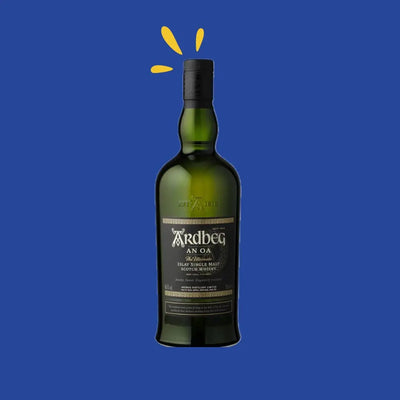
Peat, how it works
Peat is organic matter formed by the slow decomposition of vegetation in waterlogged soils over thousands of years. It burns slowly, releasing dense, aromatic smoke.
In whisky, it is used at a single stage: drying the malted barley. The germinated barley is dried over a peat fire, and the smoke infuses the grain with phenolic compounds.
These compounds are measured in parts per million. An unpeated whisky is at zero, a lightly peated whisky is around 10, and whiskies from Islay's south coast are among the highest on the market.
To understand the subject in detail, see our guide to peated whisky.
The purifier, the detail that changes everything
This is Ardbeg's technical peculiarity, and it explains why its whiskies are not just smoke.
The distillery uses a device called a purifier on its second distillation still. Its role: to return some of the heaviest vapours to the still so they can be re-distilled, instead of passing directly into the condenser.
The result is a lighter and fruitier distillate than peat would lead you to expect. This is why an Ardbeg presents, behind its smoke, notes of lemon, pear, and vanilla that you would not expect.
This tension between a very pronounced peat and a refined distillate is the house's signature.
The available range
An Oa
The most accessible of the range, named after an Islay bay. Its peculiarity lies in its blend: whiskies from several types of casks are brought together in a large wooden vat before bottling, which harmonises the whole.
The result is rounder and smoother than the other expressions, with notes of chocolate, spices, and dried fruit behind the smoke. This is the Ardbeg to choose for a first approach. See Ardbeg An Oa.
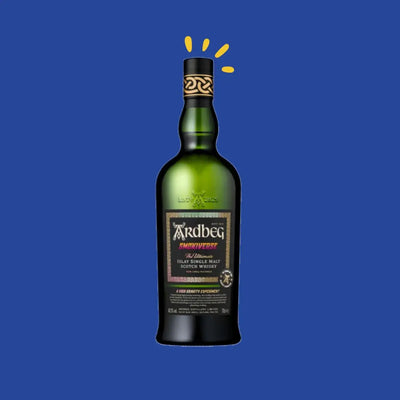
Smokiverse
One of the distillery's recent expressions, in the line of releases that explore different facets of peat. See Ardbeg Smokiverse.
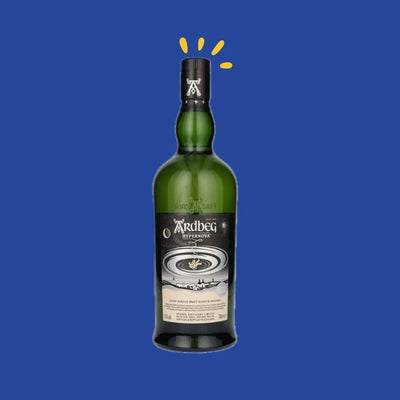
Hypernova, Committee Release
Committee Releases are bottlings reserved primarily for members of the distillery's fan club, produced in limited quantities and never re-released.
Hypernova stands out for its particularly high level of peat, even for the distillery. It is a bottle for the discerning enthusiast, and a collector's item. See Ardbeg Hypernova, Committee Release 2022.
Ardbeg 25 Year Old
The pinnacle of the range. A quarter of a century of ageing transforms the peat: it does not disappear, but it blends in, making way for notes of wax, candied fruit, minerals, and fine wood.
Given the distillery's production history, bottlings of this age are rare by design. See Ardbeg 25 Year Old.
How to enjoy an Ardbeg
- The glass: a tulip glass with a narrow rim, such as a Glencairn. A wide tumbler completely disperses the aromas.
- The temperature: room temperature. Cold closes the peat.
- The water: just a few drops, and only at a high temperature. They can open up notes that the alcohol was masking.
- Time: essential. An Ardbeg changes enormously between the first and tenth minute. The smoke fades and the fruit appears.
- No ice: it destroys the complexity of these whiskies.
Pairings
Oysters, smoked salmon, powerful blue cheeses, very cocoa-forward dark chocolate. The pairing with oysters is spectacular: the iodine of the shellfish and the peat respond directly to each other.
Frequently asked questions
Is Ardbeg too peated to start with?
An Oa is the most affordable of the range and makes a good entry point. But let's be clear: if you do not like smoke, no expression from this distillery will convince you.
Why are old Ardbegs so expensive?
Because the distillery had a production interruption in the 1980s. The old stocks are therefore objectively limited, regardless of any commercial strategy.
What is a Committee Release?
A bottling reserved primarily for members of the distillery's fan club, produced in limited quantities and not continued.
How to store a bottle?
Upright, never laid flat, away from light, at a stable temperature. Laid flat, the whisky will attack the cork.
Ordering an Ardbeg from Le Caveau des Pépites
We work directly to guarantee the origin and traceability of every bottle. Stored in our climate-controlled, humidity-controlled warehouses in France, hand-packed and packaged, shipped from mainland France via tracked and insured transport. Free delivery on orders over 300 euros. Customer service available 7 days a week, in French and English.
To learn more: our Ardbeg buying guide, our whiskies and our spirits.