
Progress from the lowest to the highest dosage: brut nature with the oysters, blanc de blancs with the starter, rosé with the main course, and demi-sec with dessert. Also increase the temperature from 8 to 12°C. Allow half a bottle per person in total.
The golden rule: never go back
A meal served entirely with champagne is possible and often more harmonious than a succession of white then red wine. There is only one rule that makes it work: each bottle must be more dosé, more vinous, or richer than the previous one. A brut served after a demi-sec seems thin and metallic, and an extra-brut after a vinous rosé seems hollow. The order is not a convention; it is a matter of perception: the palate adapts to the last wine drunk and judges the next by comparison.
A second, lesser-known principle: the temperature increases with the meal. A crisp champagne is served at 8°C, a vinous champagne at 11 or 12°C. Serving a full-bodied cuvée too cold completely stifles it.
Our pick for this article
The service plan, course by course
| Course | Champagne type | Dosage | Temperature | Glass |
|---|---|---|---|---|
| Oysters, seafood | Brut nature or extra-brut | 0 to 6 g/l | 8°C | Medium tulip |
| Seafood starter, scallops | Blanc de blancs | Brut, 6 to 9 g/l | 9 to 10°C | Large tulip |
| Main course, poultry or white meat | Rosé or blanc de noirs | Brut | 11 to 12°C | Large white wine glass |
| Cheese | Vinous or demi-sec champagne | Brut to demi-sec | 11°C | White wine glass |
| Dessert, Yule log | Demi-sec | 32 to 50 g/l | 6 to 8°C | Medium tulip |
Why brut nature with oysters
The iodine and saltiness of the oyster call for a wine with no sugar at all. Three grams of dosage is enough to create a slightly sweet impression that pairs poorly with seawater. A brut nature, dosé between 0 and 3 g/l, leaves the iodine intact and cleanses the palate between two oysters.
Why blanc de blancs with the starter
Chardonnay alone provides a straight acidic backbone and a saline finish that accompany scallops, lobster, and fine fish without overpowering them. This is the course where a slightly more ambitious cuvée is justified, as the guests are seated and attentive.
Why rosé with the main course
A champagne rosé contains red champagne wine in its blend, or comes from a short maceration. It therefore has a structure and red fruit capable of holding up against roasted poultry, stuffed capon, or duck breast. This is the point in the meal where a crisp white would disappear.
Why demi-sec with dessert
A wine must be at least as sweet as the dessert it accompanies. Anything less makes it seem acidic and metallic. A demi-sec, between 32 and 50 g/l, holds up to a Yule log, fruit tart, or gingerbread. Served slightly cooler, at 6–8°C, it retains its freshness.
Four bottles in succession
Drappier Brut Nature Drappier, from €47.20
Zero dosage, on a base of Pinot Noir from the Côte des Bar: the attack is frank, the finish straight, without the slightest sweet impression. This is the bottle for oysters, shellfish, and iodized starters. Serve it at 8°C, first, never after another cuvée.
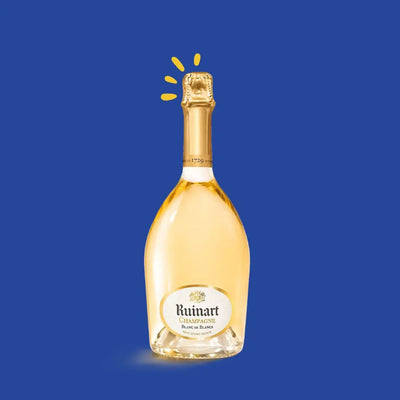
Ruinart Blanc de Blancs Ruinart, from €97.50
Chardonnay alone, with aromas of citrus and white flowers, a straight palate, and a long saline finish. The ideal course is a seafood starter: lightly seared scallops, warm lobster, or fish in a salt crust. Open it at the table and pour it into a large glass, not a flute.
Billecart-Salmon Rosé Billecart-Salmon, from €75
The house of Mareuil-sur-Aÿ, founded in 1818, built its reputation on the finesse of its rosés. Fresh red fruit, delicate texture, and enough structure for a main course. This is the glass for capon, duck, or truffle risotto. Serve at 11 or 12°C.
Taittinger Demi-Sec Taittinger, from €49.90
The final glass of the meal, with 32 to 50 g/l that holds up to a Yule log without overpowering it. The house's share of Chardonnay retains a clean finish where other demi-secs become heavy. It also works very well with a blue-veined cheese if you serve the cheeses before dessert.
Quantities and logistics for a table of eight
For a full meal, allow half a bottle of champagne per person, across all courses. For eight guests, this means four 75 cl bottles, distributed as follows: one for the aperitif and oysters, one for the starter, one for the main course, and one for dessert. If the aperitif is long, add an extra bottle to the first service.
- Glasses. Allow two glasses per person, not four. You change glasses once, when moving from blanc de blancs to rosé.
- Staggered chilling. Put the first two bottles in the refrigerator in the afternoon, and the next two one hour before they are served, so they reach 11 or 12°C.
- Opening at the last minute. Each bottle is opened when it is served, not all at the beginning of the meal.
- Resting after delivery. Stand bottles upright for 48 hours before opening. Our bottles are stored in climate-controlled warehouses with controlled humidity, and each package is carefully wrapped with proper protection to guarantee the condition of your bottles.
The three mistakes that break the progression
The first is serving the finest bottle at the aperitif. The guests are standing, the palate is fresh, but their attention is elsewhere. Save it for the starter or the main course.
The second is inserting a tannic red wine in the middle of the sequence and then returning to champagne. The tannins saturate the palate, and the following champagne seems acidic and thin. If you insist on a red, place it last before dessert, and finish with the demi-sec after a break.
The third is keeping all the bottles in the same ice bucket. Each service has its own temperature, and a vinous rosé served at 6°C loses most of what justifies its price.
To learn more
- What champagne for the December 24 aperitif
- Champagnes for December 31 and New Year's
- Champagne and galette des rois
Frequently asked questions
How much champagne should I allow for a full meal?
Half a bottle per person, across all courses. For eight guests, four 75 cl bottles are enough, adding one bottle if the aperitif lasts more than an hour.
Should I change glasses for each course?
Two glasses per person are enough: one for the first two courses, one for the rosé and dessert. Changing glasses prevents the remnants of a crisp wine from making the next one taste harsh.
Can I serve a single champagne throughout the entire meal?
Yes, by choosing a full-bodied brut blend with a dominant Pinot Noir, which will hold up from the aperitif to the main course. You will need another wine for the sweet dessert, however.
In what order should I serve blanc, rosé, and demi-sec?
From the least dosé to the most dosé, and from the crispest to the most vinous: brut nature, then blanc de blancs, then rosé, then demi-sec. Never go back in this progression.
Plan your holiday menu
Brut nature, blanc de blancs, rosé, and demi-sec: the four courses of the meal.
View all champagnesMore than 1,000 customers have already trusted us, with a rating of 4.9 out of 5. Shipped from France, payment in installments is available with Klarna.
The prices and availability mentioned are those observed at the time of publication and may change. Excessive alcohol consumption is harmful to health; consume in moderation. Sale prohibited to minors.