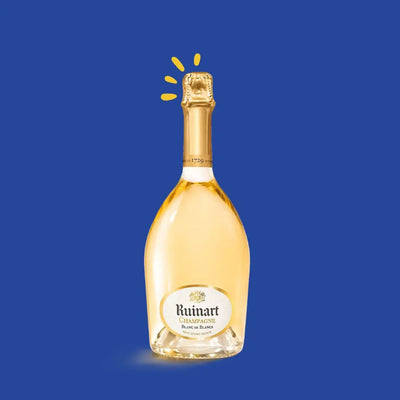
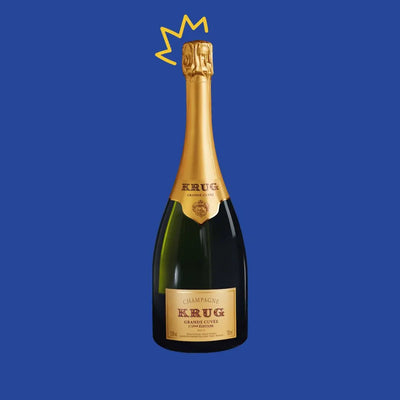
Short answer: hold the cork firmly and turn the bottle, never the other way around. The cork should come out with a quiet hiss, not a bang. Champagne at 10 degrees opens safely; lukewarm or shaken champagne shoots its cork out at over 40 kilometers per hour.
To see our selection, visit our champagnes.
Before opening
- Chill the bottle to 10 or 12 degrees. Cold reduces the internal pressure and makes opening much safer.
- Do not shake the bottle. If it has traveled, let it rest for at least an hour in a cool place.
- Prepare a napkin for the grip and to wipe the neck.
- Aim at a 45-degree angle and point the bottle away from people and fragile objects.

The five steps
1. Remove the foil
Tear the tab or cut the foil under the ring with a knife. There is no need to remove it all.
2. Untwist the cage
Six half-turns on the wire loop. From this point on, keep your thumb on the cork: the pressure may be enough to expel it.
You can leave the cage in place, slightly loosened: it provides a better grip.
3. Grip the cork
Wrap the cork in the napkin and hold it firmly. The hand serves as a vise, not a lever.
4. Turn the bottle, not the cork
This is the key point. The hand holding the cork remains still. The other hand rotates the bottle by its base.
You feel the cork push. Hold it back, slow its exit.
5. Let the gas escape slowly
Tilt the cork slightly to let the air pass in a sigh. The proper sound, that of sommeliers, is a whisper.
Why avoid noise
A bang expels some of the carbon dioxide at once. The remaining bubbles are larger and less persistent.
A jumping cork also often takes a little wine with it. And on a prestige champagne, it remains a waste.
See the Champagne Salon 2013.
Serving in glasses
- Pour in two stages: a little at the bottom, let the foam settle, then top up.
- Tilt the glass as if it were a beer: the foam rises less.
- Fill to two-thirds, no more.
- Prefer a white wine glass to a flute for a large champagne: the aromas develop much better in it.
Sabrage
Sabrage consists of slicing the neck of the bottle with a blade stroke along the glass seam.
How it works
Contrary to popular belief, it is not the sharpness that cuts. The blade strikes the glass ring at the point where the seam weakens it. The internal pressure does the rest: the ring detaches cleanly, with the cork.
The back of a knife, or even the foot of another glass, works just as well as a saber.
Precautions
- Very cold bottle, absolutely. Cold glass breaks more cleanly.
- All foil and cage removed.
- A firm and continuous motion along the seam, toward the ring. Hesitation is what makes the neck shatter.
- No one in front, at a good distance.
- Check the neck afterward. A successful cut is clean.
Sabrage is spectacular but remains an exercise. On a valuable bottle, the classic opening is wiser.
Common mistakes
- Turning the cork: it risks breaking in two, and extraction becomes delicate.
- Releasing the cage without holding the cork: this is the moment when most accidents happen.
- Opening a lukewarm bottle: the pressure is much stronger.
- Shaking before opening: never, unless the goal is to spray a podium.
Frequently asked questions
What to do if the cork is stuck?
Run the neck under warm water for a few seconds, or use a champagne cork puller. Never force it with a corkscrew.
Should you keep the cage?
You can leave it loosened around the cork during opening, it improves the grip.
Why is a champagne bottle so thick?
It contains about 6 bars of pressure, or three times that of a car tire. The glass is designed for this.
Is a magnum harder to open?
No, the technique is identical. It is simply heavier: place it on a stable surface and turn the bottle.
Ordering from Le Caveau des Pépites
We work directly to guarantee the origin and traceability of each bottle. Storage in our climate-controlled warehouses with controlled humidity in France, hand-cushioning and packaging, shipping from mainland France with tracked and insured transport. Free delivery from 300 euros. Customer service available 7 days a week, in French and English.
To go further: riddling and disgorgement.