




When we talk about Ruinart, we are not simply talking about a champagne house. We are talking about a starting point, an origin, a key moment in the history of sparkling wine. Founded in 1729, Ruinart is recognised as the first champagne house, but this position is not explained by age alone. It rests on a vision, an ability to understand its time, and a heritage built over several generations.
An era of transformation
At the end of the 17th century, the Champagne region was beginning to make a name for its wines. Yet champagne as we know it today was still far from mastered. The bubbles, sometimes unstable, were as much a curiosity as a technical challenge.
In this context, the wine of Champagne gradually caught the attention of the elite. It circulated in aristocratic circles, particularly in Paris, where it became a mark of distinction. But it remained marginal in organised trade.
This is precisely when Dom Thierry Ruinart came in. A cultured monk, open to the world, he observed the changes in society and sensed a transformation under way. For him, champagne was not just a wine: it was an opportunity, a product capable of winning over the great courts of Europe for the long term.
Our pick for this article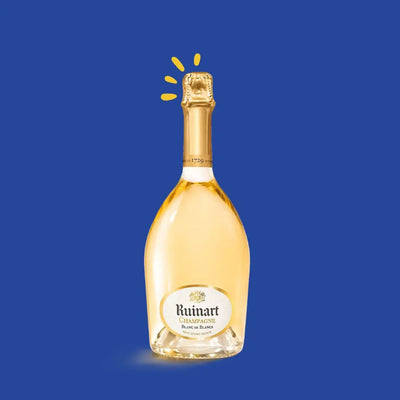
From an idea to a decision
The real birth of the house rests on Nicolas Ruinart, who decided in 1729 to turn this intuition into a concrete project. At the time, the Ruinart family worked in the textile trade, a stable and well-established business.
Champagne was introduced as a sideline, often offered as a commercial gesture. But faced with growing interest in this wine, Nicolas Ruinart quickly understood that its potential went far beyond that.
He then made a defining choice: to gradually leave textiles and devote himself to developing champagne. This decision marked a break, but above all a major step forward in the history of the sector. For the first time, a house devoted itself entirely to the production and distribution of champagne.
Building a house
From this foundation, Ruinart did more than produce wine. It organised its business, structured its trade and developed a real commercial model.
Ruinart champagne first circulated in France, then quickly across Europe. It won over a demanding clientele, attracted by novelty but also by the image of refinement it conveyed. The house understood the importance of this perception and gradually built an identity based on quality and prestige.
This period was essential, because it laid the foundations of what champagne would become: a product associated with elegance, celebration and a certain art of living.
A style that grew stronger over time
Over the decades, Ruinart refined its style. The house stands out in particular for its use of Chardonnay, which became a central part of its identity.
This grape brings a particular signature: finesse, freshness and balance. It allows the house to produce elegant cuvées, in keeping with the image it wishes to embody.
This choice is no accident. It reflects a desire for consistency, mastery and distinction. Drawing on the terroir of Champagne, Ruinart developed an approach that combines tradition and precision.
Reims, a historic home
Ruinart's history is deeply linked to Reims, the emblematic city of Champagne. This is where the house settled and developed an essential part of its heritage.
Among its most striking features are the crayères, vast cellars dug into the chalk. They offer ideal conditions for keeping bottles, allowing champagne to age in a stable environment.
But these cellars are much more than a production tool. They embody continuity, a direct link with the past. They are a reminder that champagne is also a matter of time, patience and transmission.
Continuity through the centuries
What sets Ruinart apart is its ability to cross the ages without losing its identity. Since its founding, the house has been through changes and new contexts, but it has preserved what matters most: its heritage.
Each generation has helped enrich this story while respecting the foundations laid in the 18th century. This continuity gives the house a particular depth, which strengthens its legitimacy.
Far from being frozen, this tradition goes hand in hand with constant adaptation. Ruinart evolves with the times while keeping a clear direction.
A history that has become a signature
Today, Ruinart's history is an integral part of its identity. It is not just a story about the past; it shapes how the house is perceived.
Being the first champagne house is a central element. This historic position gives it strong legitimacy, built on nearly three centuries of existence.
But beyond its age, what stands out is the consistency of its path. From the initial vision to the building of a prestigious image, each step follows a clear logic.
Conclusion
The history of Ruinart is a story of transformation. That of a wine that became a symbol, an intuition that became reality, and a house that built a lasting heritage.
In 1729, Nicolas Ruinart laid the foundations of a new model. Inspired by the vision of Dom Thierry Ruinart, he created a house that would become a reference.
Since then, Ruinart has embodied a certain idea of champagne: a combination of tradition, elegance and continuity. A story that does not stop in the past, but continues to influence the present. Discover our Ruinart champagnes.





