Short answer: a young, unoaked Chablis, a Muscadet sur lie, or a Blanc de Blancs Champagne. All three share what is needed: high acidity, a saline finish, and no oak. Serve at 10 to 12 degrees Celsius, never ice-cold.
To see our selection, browse our white wines.
Why the pairing is tricky
A seafood platter poses three problems for a wine.
- Iodine: oysters, whelks, and shellfish bring a marine salinity that overwhelms soft wines.
- The delicacy of the flesh: a wine that is too powerful completely covers it.
- Diversity: oysters, shrimp, skate, and spiny lobsters do not call for exactly the same wine.
You therefore need a lively, dry, unoaked wine with a saline sensation that responds to the iodine rather than fighting against it.
Our pick for this article
The three sure bets
1. Chablis
The most famous pairing, and it really works.
Chardonnay grows there on a Kimmeridgian soil laden with 150-million-year-old oyster fossils. The anecdote is charming, but what really matters is the result: sharp acidity, saline finish, no oak.
Take a young Chablis villages. A Grand Cru would be almost too rich for this use.
See the Chablis 2023 Grand Regnard and our Chablis guide.
2. Blanc de Blancs Champagne
The bubbles cleanse the palate between two bites, the acidity of the Chardonnay responds to the iodine, and the chalky salinity of the Côte des Blancs creates a perfect echo.
It is probably the most accomplished of the three pairings, and the most festive.
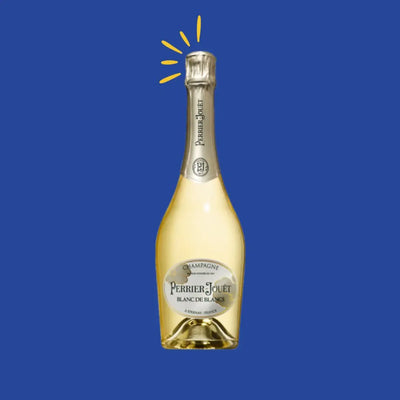
See the Perrier-Jouët Blanc de Blancs and our Blanc de Blancs.
3. Muscadet Sèvre-et-Maine sur lie
The value-for-money choice. Lively, saline, light, it costs almost nothing and does the job perfectly.
The "sur lie" designation means that the wine spent the winter on its fermentation lees, which gives it body and a slight effervescence.
Other good options
- A Picpoul de Pinet: lemony, saline, designed for the oysters of the Étang de Thau.
- A Sancerre or Menetou-Salon: Sauvignon on Kimmeridgian soil works very well. See our comparison.
- A dry Alsatian Riesling: taut and direct, excellent with crustaceans. See our Alsace selection.
- A Premier Cru Chablis: if your platter includes many richer cooked crustaceans.
What to avoid
- An oaked Chardonnay: vanilla and oak clash directly with iodine. This is the most common mistake.
- A red wine: tannins react with the iodine from shellfish and produce an unpleasant metallic sensation.
- A wine that is too aromatic: a Gewürztraminer or Viognier completely covers the seafood.
- A soft rosé: without acidity, it disappears.
- A wine served ice-cold: at 5 degrees, there is nothing left to smell.
Serving temperature
10 to 12 degrees Celsius. This is the parameter most often gotten wrong.
To do it quickly: a bucket filled with water, ice cubes, and a handful of coarse salt cools a bottle in twenty minutes. The refrigerator takes three hours.
Take the bottle out of the bucket a few minutes before serving: otherwise, it will continue to cool in the ice.
Adapt according to the platter
- Lots of oysters: Muscadet, young Chablis, Picpoul.
- Cooked crustaceans dominate: Premier Cru Chablis, Blanc de Blancs Champagne.
- Lobster or spiny lobster: a great Blanc de Blancs or a slightly oaked Chardonnay from the Côte de Beaune becomes possible.
- With mayonnaise or a sauce: you need a little more body in the wine.
- With plenty of lemon: increase the acidity in the wine, otherwise it will seem flat.
How many bottles to plan for
Count half a bottle per person for a platter served as a main course, three-quarters of a bottle if the meal lasts.
A 75-centiliter bottle fills about six tasting glasses, four generous table glasses.
Frequently asked questions
Chablis or Muscadet?
Chablis for more depth and length, Muscadet for value for money and pure liveliness.
Can you serve Champagne with oysters?
Yes, provided it is Brut or Extra-Brut. A Demi-Sec would be out of place. See our dosage guide.
Why no red?
Tannins react with the iodine from shellfish and give a very distinct metallic taste.
Should it be decanted?
No. These wines are designed to be drunk lively and immediately.
Order your white wine from Le Caveau des Pépites
We work directly to guarantee the origin and traceability of every bottle. Stored in our climate-controlled, humidity-controlled warehouses in France, hand-packed and wrapped, shipped from mainland France via tracked and insured transport. Free delivery from 300 euros. Customer service available 7 days a week, in French and English.
To go further: our Champagnes.