Among the great crus of Vosne-Romanée, the differences are a matter of a few dozen meters. La Tâche occupies a position apart.
To see what is available, visit the Domaine de la Romanée-Conti collection.
The climate
La Tâche covers about six hectares south of the village of Vosne-Romanée, as a monopole.
The climate extends over a longer slope than its neighbors, giving it internal diversity: the top, middle, and bottom of the plot do not have exactly the same soil or exposure.
What this diversity brings
This is one of the explanations put forward for its reputation as the most complete wine in the area: the blend of the different zones of the plot gives structure, fragrance, and flesh.
Where a very small and very homogeneous climate expresses a single facet with extreme precision, La Tâche combines several registers.
Our pick for this article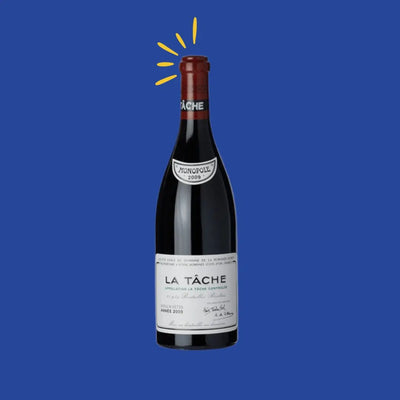
The soil
- Jurassic limestones in the subsoil, fissured, allowing deep rooting.
- Marls mixed with clay, which retain water and give body.
- Stony scree on the surface, which drains and warms.
- Moderate soil depth: enough to nourish, not enough to let the vine go.
The style
On the nose
In its youth: black cherry, raspberry, violet, a spicy note linked to whole-bunch fermentation, and new oak.
With age: faded rose, forest floor, truffle, leather, tobacco, sweet spices. The register becomes very complex.
On the palate
A precise attack, a dense mid-palate for a Pinot Noir, fine and tight tannins, and above all, exceptional persistence.
The most cited marker is its length: the wine remains in the mouth long after it has been swallowed, transforming.
See La Tâche Grand Cru.
Whole-bunch fermentation
This is a decisive technical choice in the style of these wines.
Most estates destem, that is, separate the berries from the stems, the green structure that holds the bunch. Others keep all or part of the whole bunches.
What the stems bring
- Tannic structure: the stems contain tannins different from those of the skin.
- Freshness: they slightly lower the alcohol content and bring a sensation of tension.
- A spicy and floral register: pepper, tea, rose.
- Increased aging potential.
The risk
If the stems are not perfectly ripe, they bring a green bitterness and an unpleasant astringency. This is why whole-bunch fermentation can only be done with very ripe grapes, therefore on great terroirs and in good vintages.
Aging
- From 0 to 8 years: the wine is closed. The oak and structure dominate.
- From 8 to 15 years: it begins to open, but it remains developing.
- From 15 to 30 years: the great window. This is when the wine gives everything.
- Beyond: the great vintages continue to evolve for decades.
Service, in detail
- Stand upright 48 hours before: the sediment must gather at the bottom.
- Open with care: on an old bottle, the cork can be fragile. A screw cap is sometimes preferable.
- Decant briefly: only to separate the sediment. Aged Pinot Noir does not like long decanting.
- Serve at 15 or 16 degrees, in a Burgundy glass filled to a quarter.
- Take your time: taste every fifteen minutes, the wine changes.
Food pairings
- Squab: roasted pink, it is the reference pairing.
- Bresse poultry: simply roasted.
- Mushrooms: morels in cream, pan-seared porcini.
- Truffle: in risotto or with poultry.
- Young Époisses: classic regional pairing, provided the cheese is not too ripe.
Frequently asked questions
Why La Tâche rather than another Grand Cru?
For its completeness: structure, fragrance, and flesh combined, where other climates express a more precise but narrower facet.
What is a Grand Cru in Burgundy?
The top of the hierarchy, attributed to the climate itself and not to the property. They represent about one percent of Burgundy production.
Should it be decanted?
As little as possible on an aged bottle. Decant to separate the sediment, then serve.
What other Vosne Grand Crus are there?
Richebourg, Romanée-Saint-Vivant, Grands-Échezeaux, Échezeaux. See our guide to the Grand Crus of Vosne-Romanée.
Ordering from Le Caveau des Pépites
We work directly to guarantee the origin and traceability of each bottle. Stored in our climate-controlled warehouses with controlled humidity in France, hand-packed and wrapped, shipped from mainland France with tracked and insured transport. Free delivery from 300 euros. Customer service available 7 days a week, in French and English.
To learn more: the Domaine de la Romanée-Conti.