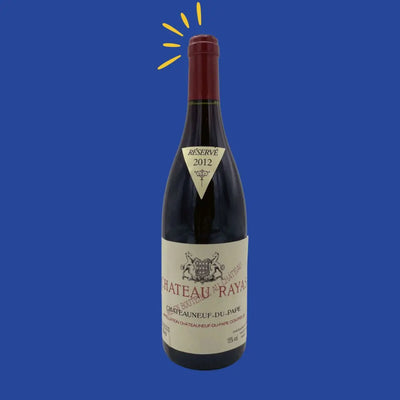
Some wines are tasted; others are told. Château Rayas clearly belongs to the second category. Long before it was recognised for its finesse or complexity, Rayas was a story: one of silence, transmission, radical choices and a vision almost opposed to the standards of its time.
It all began in the early 20th century, when the estate was taken over by the Reynaud family. At that time, Châteauneuf-du-Pape was already a recognised appellation, but its codes were very different from today's. The wines were powerful, structured and often defined by blending. Yet in the middle of this landscape, Rayas would follow another path.
The story of Rayas is above all one of refusal. A refusal to do as others did. A refusal to give in to trends. A refusal to over-optimise. Where some sought to produce more, Rayas chose rarity. Where others pursued power, Rayas pursued finesse.
This positioning was not built in a day. It is the fruit of a vision passed down from generation to generation with almost stubborn fidelity. Jacques Reynaud, the estate's iconic figure, perfectly embodied this spirit. Discreet, almost mysterious, he did much to build the estate's aura without ever seeking publicity.
This discretion is at the heart of the Rayas story. Unlike other great estates, there is no communication strategy and no staging. The wine exists on its own, carried only by those who taste it and talk about it. This absence of official discourse created a void, quickly filled by enthusiasts, critics and connoisseurs. It is precisely in that space that the myth was built.
Each bottle thus becomes a story, an experience that is shared, described and passed on. The words used are always the same: singular, unclassifiable, mysterious, unique. People are not just talking about a wine, but about a sensation that is hard to explain, almost elusive.
Terroir also plays a central role. The choice to work on sandy soil, against the standards of the appellation, is significant. This sand, often considered less prestigious than the famous rolled pebbles, becomes a key element here. It gives rise to a wine of rare elegance and almost disconcerting finesse.
But beyond the terroir, it is the way it is respected that stands out. At Rayas, everything seems guided by a deliberate simplicity. Winemaking is minimalist, almost austere. No artifice, no search for effect. Just a desire to let the wine express itself.
This approach reinforces the idea that Rayas is a timeless wine. A wine that does not seek to charm immediately, but to make its mark gently and patiently. A wine that asks to be understood and tamed.
The story of Rayas is also one of rarity. Very early on, the estate chose to produce little, not out of constraint but out of conviction. This low production created a natural tension between supply and demand. Over the years, bottles became harder and harder to find. They circulate little and are passed on and kept.
This fuels an extremely strong sense of desire. Rayas becomes a wine people search for, wait for and hope for. It is sold through allocations reserved for a privileged few, an exclusivity that further strengthens its image.
Gradually, the market seized on this rarity. Prices rose, the wine's value climbed and auction results soared. But unlike other wines that became speculative, Rayas has kept a very strong emotional dimension. It cannot be reduced to a figure or a rating. It remains a wine people dream of tasting.
What is fascinating is that despite this rise, the estate never changed course. No massive increase in production, no marketing repositioning. Rayas remains true to itself, as if frozen in time.
This consistency is a large part of its legend. In a world where everything changes quickly and trends come and go, Rayas offers a form of stability, a continuity that many enthusiasts find reassuring.
But this story is not only about an estate. It is also about those who talk about it. Sommeliers, critics, collectors: each adds to the edifice. Each recounts their experience, their feelings, their interpretation. And it is this accumulation of stories that gives Rayas its mythical dimension.
Some describe a wine of extreme delicacy, almost fragile. Others speak of a deep complexity that reveals itself over time. Some mention exceptional length, others an incomparable silky texture. These descriptions, sometimes contradictory, reinforce the idea that Rayas cannot be summed up.
There is also debate. Some enthusiasts question its status and sometimes consider it overrated. But even these criticisms are part of the story. A wine that sparks debate is a living wine, one that provokes reactions.
Today, Château Rayas is much more than an estate. It is a reference, a symbol, an enigma. A wine that continues to fascinate precisely because it escapes the usual rules.
Telling the story of Rayas is not just describing a wine. It is telling the story of a vision: a way of doing, thinking and resisting. It means understanding that behind every bottle lies a story of choices, convictions and silence.
And that, ultimately, is no doubt what makes Rayas so unique.