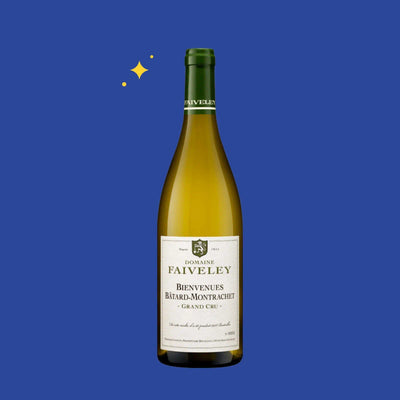
In Burgundy, there are a handful of plots whose names are enough to silence a table. Bâtard-Montrachet is one of them. Less than twelve hectares of Chardonnay, planted at the foot of a slope between two villages, producing one of the most sought-after white wines in the world. And a name that intrigues everyone: why "Bâtard"?
We'll tell you the story in 50 seconds, then in detail.
Where exactly is Bâtard-Montrachet located?
Bâtard-Montrachet is a Grand Cru of the Côte de Beaune, in Burgundy, planted exclusively with Chardonnay. Its 11.86 hectares straddle two municipalities: Puligny-Montrachet to the north and Chassagne-Montrachet to the south. The administrative boundary runs through the middle of the vineyards, with no marker on the ground.
The vineyard is located at the foot of the slope, below Montrachet itself, at an altitude of around 240 to 250 meters. This difference of a few dozen meters explains almost everything that follows.
Our pick for this article
The legend of the Lord of Montrachet
The version told in the cellars of the Côte is as follows. A long time ago, the Lord of Montrachet had a legitimate son who left for the Crusades: the Chevalier. The son never returned. The Lord, left alone on his land, had a child with a peasant woman from the village: the Bâtard. At the child's birth, people supposedly shouted "welcome!" in the vineyards, and these cries of joy gave their names to the neighboring plots.
This is how the five names of the family are still explained today: Montrachet for the father, Chevalier-Montrachet for the legitimate son, Bâtard-Montrachet for the illegitimate one, Bienvenues-Bâtard-Montrachet for the welcome, and Criots-Bâtard-Montrachet for the cries.
What historians say
The story is beautiful, but it is late and likely invented for visitors. Toponymists offer much more down-to-earth explanations, and more interesting for understanding the wine:
- Montrachet supposedly comes from "mont rachet", the bald, shorn mount, without trees: a bare hill exposed to the rising sun.
- Bâtard supposedly refers to a bastard land, that is, land of mixed nature, half good, half bad. Heavier, more clayey soil that the peasant considered less noble than the slope above.
- Criots supposedly refers to "cray", chalky soil, and not to cries.
In other words: the name that sounds like an insult is actually a geological description. And this "bastard" land today produces bottles that fetch four figures.
The five Grand Crus of the Montrachet family
All were classified as Grand Crus in 1937, when the Burgundy appellations d'origine contrôlée were created. All are Chardonnay.
| Grand Cru | Area | Municipalities |
|---|---|---|
| Montrachet | around 8 ha | Puligny and Chassagne |
| Chevalier-Montrachet | around 7.4 ha | Puligny only |
| Bâtard-Montrachet | 11.86 ha | Puligny and Chassagne |
| Bienvenues-Bâtard-Montrachet | around 3.7 ha | Puligny only |
| Criots-Bâtard-Montrachet | around 1.6 ha | Chassagne only |
Together, these five appellations cover less than 33 hectares. That is the equivalent of 45 football fields, to supply the entire planet. And since Burgundy property is fragmented, a single plot can be shared among several dozen owners, some of whom produce only a few hundred bottles a year. This is why these wines are so rarely found for sale.
Why Bâtard does not taste the same as Montrachet
The two plots touch. Yet the wines do not resemble each other, and the difference can be seen in the soil.
Montrachet is on the mid-slope, on shallow, highly draining limestone. The roots suffer, yields are low, the wine is born tense, upright, with an exceptional aging capacity.
Chevalier is above, on the leanest and rockiest part of the slope. It is the most vertical, the most mineral, the most austere in its youth.
Bâtard is at the bottom, where colluvium has accumulated over the centuries. Deeper, more clayey soil that retains more water. Result: more substance, more richness, more power, a maturity that arrives earlier. It is the fullest-bodied and most immediately appealing of the five.
Recognizing a Bâtard-Montrachet blind
The color is light gold to green gold, dense, luminous. The nose combines toasted hazelnut, fresh butter, acacia honey, candied citrus fruits and, with age, a note of white truffle and wax. The palate is ample, broad, almost opulent, but an underlying salinity prevents it from becoming heavy. The finish is long, slightly bitter, on citrus zest.
The key to remember: if the wine seems broad to you before being tense, you are closer to Bâtard than to Chevalier.
Aging, service and pairings
- Aging: 8 to 25 years depending on the vintage and the estate. The most comfortable window is between 8 and 15 years.
- Temperature: 12 to 13 °C. Colder, the wine closes up and you lose what you paid for.
- Glass: a large white Burgundy glass, or a wide decanter 30 minutes before if the bottle is less than 10 years old.
- Pairings: butter-roasted lobster, Bresse poultry with cream, sweetbreads, turbot, white truffle, 36-month-old Comté.
How much does a Bâtard-Montrachet cost?
Generally, expect to pay between €400 and €1,200 per bottle at an established estate, and well over that for the rarest signatures, some of which are never publicly released. The rarity does not come from artificial speculation: it is mechanical. Less than 12 hectares, about fifty owners, and global demand.
Our bottles from the Montrachet family
- Bâtard-Montrachet Grand Cru 2023, Louis Jadot
- Bienvenues-Bâtard-Montrachet Grand Cru 2023, Domaine Faiveley
- Bienvenues-Bâtard-Montrachet Grand Cru 2020, Olivier Leflaive
- Chevalier-Montrachet Grand Cru Les Demoiselles 2022, Héritiers Louis Jadot
- Montrachet Grand Cru 2015, Domaine Jacques Prieur
To learn more, browse our selections of Bâtard-Montrachet, Montrachet, Puligny-Montrachet, Chassagne-Montrachet and Grands Crus.
Frequently asked questions about Bâtard-Montrachet
Why is Bâtard-Montrachet called that?
Legend has it that a Lord of Montrachet had an illegitimate son after the death of his eldest son who left for the Crusades, hence the names Chevalier and Bâtard. The most credible explanation, however, is geological: a "bastard" land referred to a soil of mixed nature, deeper and more clayey than the slope above.
Is Bâtard-Montrachet a white or red wine?
It is a dry white wine, made from 100% Chardonnay. No red wine can claim this appellation.
What is the difference between Bâtard-Montrachet and Bienvenues-Bâtard-Montrachet?
Bienvenues-Bâtard-Montrachet is an enclave of around 3.7 hectares located entirely in the municipality of Puligny-Montrachet, north of Bâtard. The wines there are generally a little finer and more floral, while Bâtard plays more on power.
In which municipalities is Bâtard-Montrachet located?
In two: Puligny-Montrachet and Chassagne-Montrachet, in Côte de Beaune, in the department of Côte-d'Or.
How long can a Bâtard-Montrachet be aged?
From 8 to 25 years depending on the vintage and the estate, with a frequent peak between 8 and 15 years. Store the bottles lying down, between 11 and 14 °C, away from light and vibrations.
At what temperature should a Bâtard-Montrachet be served?
Between 12 and 13 °C. Served too cold, a great Burgundy Chardonnay closes up and loses its aromatic volume.
Why are these wines so difficult to find?
The entire set of five Grand Crus of the Montrachet family represents less than 33 hectares, fragmented among dozens of owners. Many estates produce only one or two barrels a year, reserved for their long-standing customers.
To learn more
The official appellation sheets can be viewed on the Bureau Interprofessionnel des Vins de Bourgogne website.