Beaujolais has a reputation that does not do it justice. For decades, Beaujolais Nouveau has dominated the media, to the point of obscuring what the region actually produces.
For in the north of the vineyard, ten crus produce structured, age-worthy wines that are sometimes comparable to Burgundy. To see what is available, visit the Pascal Aufranc collection.
Chénas and Juliénas
The two appellations are neighbors in the north of the vineyard, on the border between the Rhône and Saône-et-Loire. Yet they produce quite different wines.
Chénas
It is the smallest of the ten crus by area, which explains its relative rarity on the market.
The name comes from the oaks that once covered the hill before being cleared to make way for vines. The soils are granitic, sometimes sandy, with more clay-rich areas.
The style is the most structured in the area: a dense, structured wine, often floral on the nose, which readily benefits from a few years to open up.
See the Chénas En Rémont.
Juliénas
Further north, Juliénas occupies more varied slopes: granite at higher altitudes, schist and clay lower down.
The style is softer and more accessible than Chénas, with red fruits, vine-ripened peach, and a touch of spice. It is a cru that provides pleasure sooner.
See the Juliénas Les Crots.
Our pick for this article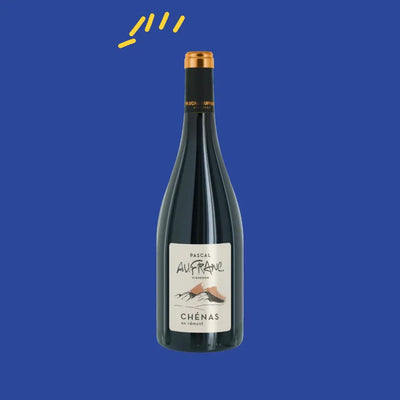
Gamay, a misunderstood grape
Gamay has suffered from a historically poor reputation. It was even banned from Burgundy in the fourteenth century, judged too productive and too rustic compared to Pinot Noir.
This decision pushed it south, onto the granitic soils of Beaujolais, where it proved perfectly at home.
What gamay produces on granite
- Vibrant fruit: cherry, raspberry, blackcurrant, with rare precision.
- Natural acidity: it makes these wines remarkably easy to drink.
- Fine tannins: less austere than Cabernet, less fleeting than Pinot.
- Minerality: on the best granitic terroirs, it is very pronounced.
Beaujolais winemaking
The region developed a particular technique: semi-carbonic maceration.
Whole, destemmed bunches are placed in the tank. The weight of the grapes crushes the berries at the bottom, which ferment normally and saturate the tank with carbon dioxide. The intact berries at the top then ferment inside the berries themselves.
This intracellular fermentation produces very fruity aromas and extracts few harsh tannins.
For age-worthy crus, winemakers generally use longer macerations, or even classic Burgundy winemaking techniques, to achieve greater structure.
The question of old vines
This is a determining factor in northern Beaujolais.
An old vine produces less, but its grapes are more concentrated. Its deep root system allows it to better resist drought and more faithfully express the subsoil.
In a region where granite is the dominant factor, this deep rooting changes the very nature of the wine.
Service and aging
- Temperature: 14 to 15 degrees. Beaujolais crus are served chilled, colder than a red Burgundy.
- Decanting: thirty minutes for a young Chénas.
- Aging: three to eight years for Juliénas, five to ten or even more for Chénas from a good vintage.
- Glass: Burgundy.
With age, Beaujolais crus take on a Burgundy character: the fruit gives way to forest floor, leather, and spices. Blind tastings have regularly fooled professionals on this point.
Food pairings
- Lyon charcuterie: rosette, parsley-flecked ham, hot saucisson.
- Poultry: roast chicken, coq au vin.
- Offal: sweetbreads, veal liver.
- Goat cheeses and soft cheeses.
- Game birds: with a few-year-old Chénas.
- Spicy dishes: the freshness of gamay absorbs chili well.
Frequently asked questions
Are Beaujolais crus Beaujolais Nouveau?
No, they have nothing to do with each other. The ten crus have their own appellations and do not produce primeur.
Chénas or Juliénas?
Chénas for structure and aging, Juliénas for softness and more immediate pleasure. See our detailed comparison.
Should they be served chilled?
Yes, 14 to 15 degrees. This is the most useful advice for these wines.
What are the ten crus?
See our guide to the ten crus of Beaujolais.
Ordering a Pascal Aufranc from Le Caveau des Pépites
We work directly with the producer to guarantee the origin and traceability of every bottle. Stored in our climate-controlled, humidity-regulated warehouses in France, hand-packed and wrapped, and shipped from mainland France via tracked and insured transport. Free delivery on orders over 300 euros. Customer service available seven days a week, in French and English.
To learn more: our article on the Château des Jacques in Moulin-à-Vent.