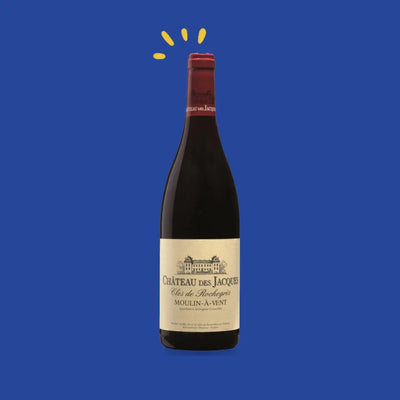
There is a Beaujolais that no one expects. Not the one from bistros and the third Thursday of November, but the one that sits in a cellar next to a Côte de Nuits and holds up for twenty years without faltering. This Beaujolais has a name: Château des Jacques, in Romanèche-Thorins, in the heart of the Moulin-à-Vent appellation.
If you are looking for a great red wine for aging without paying the price of a grand cru from the Côte de Nuits, this is probably the smartest entry point on the market. Here we detail the history of the estate, its terroirs, its winemaking method, and how to read its cuvées. You can also browse all the bottles from Château des Jacques available.
Romanèche-Thorins, the epicenter of Moulin-à-Vent
Beaujolais has ten crus. Moulin-à-Vent is the one that has always been nicknamed "the king of Beaujolais," and this nickname is no marketing gimmick. It is due to a geological peculiarity: the soils of Romanèche-Thorins and Chénas rest on weathered pink granite, locally called "gore," rich in manganese oxides.
This manganese plays a unique role. It curbs the vigor of the vine, naturally limits yields, and produces grapes that are more concentrated, more tannic, and better suited to aging than anywhere else in the region. This is why Moulin-à-Vent provides, year after year, the most structured wines of Beaujolais, those that after ten years develop notes of forest floor and spices that are usually associated with Pinot Noir.
A name from the windmill
The appellation owes its name to an authentic 15th-century windmill, still standing on the Thorins hill above the estate. It appears on many of the labels of the appellation and serves as a visual landmark for enthusiasts.
Our pick for this article
1996: the arrival of Maison Louis Jadot changes everything
Château des Jacques is an old estate, but its modern destiny begins in 1996, when the Maison Louis Jadot acquires it. For a Burgundy négociant house of this standing, buying an estate in Beaujolais was not an obvious move at the time. It was even a gamble: asserting that the Gamay of Moulin-à-Vent deserved exactly the same treatment as the Pinot Noir of Beaune or Gevrey.
This gamble was carried out with a rigor that eventually set a precedent throughout the region. If you want to understand the overall philosophy of the parent house, we have detailed it in our article on the history and estates of Maison Louis Jadot.
The Burgundy method applied to Gamay
This is where Château des Jacques radically separates itself from traditional Beaujolais. Classic Beaujolais relies on semi-carbonic vinification: whole bunches, whole-cluster maceration, gentle extraction, and immediate, vibrant fruit. Excellent for drinking young, less suited for long aging.
Château des Jacques does the opposite, working in the Burgundy style:
- Complete destemming: the stems are removed, which eliminates typical vegetal and starchy notes and makes room for ripe fruit.
- Long macerations: several weeks of maceration, whereas classic Beaujolais settles for a few days. This is what builds the tannic structure.
- Oak barrel aging: careful aging, in the Burgundy spirit, which brings volume and aging capacity without masking the terroir.
- Plot-by-plot vinification: each climat is vinified separately, as one would do with a Premier Cru.
The result does not resemble a Beaujolais from a bistro counter. It is a dense, serious wine with a tight structure, which often requires two or three years in the bottle to relax and which improves beyond ten years.
The estate's climats, read one by one
Château des Jacques highlighted the plot-by-plot approach long before it became fashionable. Each clos has its own signature.
Clos du Grand Carquelin
Often the most immediately appealing of the range. The highly draining granite soils produce a wine of pure fruit, silky texture, and remarkable tannic finesse. This is the clos we recommend for a first approach to the estate. Discover it in the Clos du Grand Carquelin 2020 in a Jeroboam or in the 2017 vintage, already opened.
Clos de Rochegrès
The other face of the estate. Rochegrès is more mineral, more austere in its youth, and longer on the palate. It is the clos for patient enthusiasts, the one that benefits most from waiting. The Clos de Rochegrès 2016 is now entering a very beautiful drinking window.
Moulin-à-Vent "Classic"
The blend of the estate's plots. Less demonstrative than a named clos, it offers the house's signature at a more accessible price point and constitutes the best starting point. See the Moulin-à-Vent 2022.
Morgon Côte du Py
The estate also produces a Morgon on the Côte du Py, the hill of weathered blue schists overlooking Villié-Morgon. The profile changes: more iron, more blood, a tension different from that of granite. An excellent counterpoint to understand what terroir really changes. See the Morgon Côte du Py 2022.
What a Château des Jacques looks like in the glass
When young, the wine presents compact black fruit, black cherry and blackberry, with a hint of pepper and still firm tannins. The palate is broader and deeper than what is expected from a Gamay, without the sweet roundness of some modern Beaujolais.
After five to eight years, the fruit develops a patina. Notes of forest floor, subtle truffle, leather, and sweet spices appear. It is at this stage that confusion with a Côte de Beaune becomes frequent in blind tastings, and that is the whole point of the estate.
Service and pairings
Serve between 15 and 16 degrees, in a fairly large glass. An hour in a decanter is useful for young vintages. At the table, the estate excels with roasted poultry, duck, white meats in sauce, fine charcuterie, and pressed-paste cheeses. On an evolved vintage, a game bird dish works remarkably well.
Frequently Asked Questions
Does Château des Jacques make Beaujolais Nouveau?
No. The estate is entirely focused on aging crus, Moulin-à-Vent and Morgon. Nothing in its range falls under the category of primeur wine.
How long can a Moulin-à-Vent from Château des Jacques be kept?
The plot-by-plot cuvées are commonly kept for ten to fifteen years, sometimes longer in great vintages. The Moulin-à-Vent blend can be very well drunk between three and eight years.
Should it be decanted?
For a vintage less than five years old, yes, for about an hour. For an older vintage, prefer opening it thirty minutes before serving, without rough decanting.
Why is this estate more expensive than a regular Beaujolais?
Limited yields, plot-by-plot vinification, long macerations, and oak barrel aging have a cost. Compared to the quality and aging potential, Château des Jacques remains one of the most favorable value-for-money options in France for red wines for aging.
Ordering a Château des Jacques from Le Caveau des Pépites
We work directly to secure the supply and traceability of every bottle. The wines are stored in our climate-controlled, humidity-controlled warehouses in France, stacked and packed by hand, then shipped from mainland France via tracked and insured transport. Free delivery on purchases of 300 euros or more. Our customer service is available 7 days a week, in French and English.
You can also compare with our other selections of red wines, our magnums and large formats, or all of our Burgundy wines.