When a wine from southern France ages for twenty years in the cellar, there is a good chance that Mourvèdre is partly responsible.
Yet it is the least well-known grape to the general public among the three pillars of southern Rhône. To see our selection, visit our red wines.
A demanding grape
Mourvèdre has a reputation as a difficult grape, and it is well-deserved.
- It ripens late: often two to three weeks after Grenache. It therefore needs plenty of heat at the end of its cycle.
- It likes its feet in the water and its head in the sun: the traditional saying summarizes its needs, deep watering and maximum exposure.
- It buds early: which exposes it to spring frosts.
- It produces little: yields are naturally limited.
- It is reductive: in the cellar, it needs oxygen, otherwise it may develop unpleasant odors.
This demanding nature explains why it is only planted in places where it can truly ripen: Bandol, southern Rhône, coastal Languedoc, and Spain under the name Monastrell.
Our pick for this article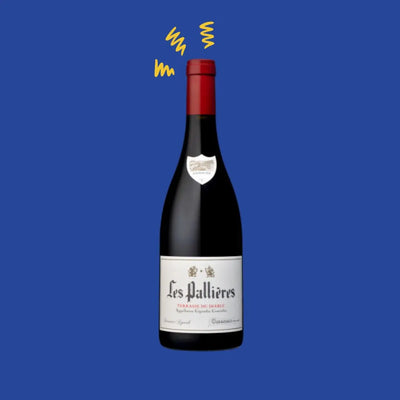
What it brings to the blend
Structure
Its tannin is firm, tight, and sometimes rough when young. This is exactly what Grenache lacks, whose tannin is supple and melting.
Color
It brings a deep color and stable anthocyanins, which resist the test of time.
Freshness
Counter-intuitive for a late-ripening grape, but it retains its acidity better than Grenache in warm years.
Aromas
Black fruits, leather, garrigue, pepper, and a characteristic animal note that some call the wild side. With age, this note evolves towards truffle and forest floor.
Longevity
This is its main contribution. A wine rich in Mourvèdre ages slowly and for a long time.
How to read a label
The proportion of Mourvèdre is almost never indicated, but a few clues allow you to guess it.
- The appellation: in Bandol, the specifications require a high proportion. It is the dominant grape of the appellation.
- The estate's messaging: producers who use a lot of it say so, because it is a key aging argument.
- The price and positioning: reserve cuvées generally contain more of it.
- The taste: firm tannin and an animal note in a southern wine signal its presence.
See the Gigondas Les Pallières 2022, a blend where Mourvèdre plays this structuring role.
Mourvèdre regions
Bandol
This is its kingdom in France. The Provençal appellation makes it its main grape, with a long aging period required by the specifications. Bandol reds are among the French wines best suited for aging.
Southern Rhône
In Châteauneuf-du-Pape, Gigondas and Vacqueyras, it complements Grenache. Its proportion varies greatly from one estate to another, and it is one of the main factors differentiating the styles.
Languedoc
Present in several coastal appellations, where it ripens well.
Spain
Under the name Monastrell, from which it probably originates, it dominates several regions of southeastern Spain.
Serving a wine rich in Mourvèdre
- Be patient: it is the grape that requires the most time. Five to ten years minimum for a structured cuvée.
- Decant for a long time: two hours for a young wine, the tannin needs air.
- Serve at 16 or 17 degrees.
- Pair it with a substantial dish: its tannin requires fat and protein.
Pairings
- Game: wild boar, roe deer, in civet or daube.
- Lamb: confit shoulder, slow-cooked.
- Sauced meats: daube, stew, beef with olives.
- Aged cheeses: pressed cheeses, sheep's milk.
- Truffle: on a mature bottle.
Frequently asked questions
Why this animal side?
It is a characteristic of the grape, linked to certain aromatic compounds. In a well-made wine, it remains discreet and contributes to the complexity.
Can it be drunk as a single-varietal?
Yes, some estates do it, especially in Bandol. The result is austere when young and magnificent at maturity.
How does it compare to Grenache?
Grenache gives the flesh and roundness, Mourvèdre gives the structure and longevity. See our guide to Grenache.
And to Syrah?
Syrah is more aromatic and more immediate, Mourvèdre more austere and longer-lived. See our guide to Syrah.
Ordering from Le Caveau des Pépites
We work directly to guarantee the origin and traceability of every bottle. Stored in our climate-controlled, humidity-controlled warehouses in France, hand-packed and wrapped, shipped from mainland France via tracked and insured transport. Free delivery from 300 euros. Customer service available 7 days a week, in French and English.
To learn more: our Châteauneuf-du-Pape.