




Dom Pérignon is probably the best-known champagne name in the world, and also one of the most misunderstood. Many people simply consider it an expensive champagne. Yet it is one of the most rigorously crafted cuvées in the region, with a unique rule that shapes everything else.
This rule is as follows: Dom Pérignon is only available as a vintage. Here is what that means. You can browse all available Dom Pérignon bottles directly.
The name, and the myth
Dom Pierre Pérignon was a Benedictine monk at the abbey of Hautvillers, in Champagne, at the end of the 17th and beginning of the 18th century. He held the position of procurator-cellarer there, responsible in particular for the abbey's vineyards and wine.
Legend credits him with inventing champagne. This is inaccurate: bottle-trapped carbonation was known elsewhere before him, and his work was even aimed at limiting effervescence, which was considered a flaw at the time.
What he really brought is more interesting: rigorous work on grape selection, on gentle pressing to obtain clear juice from black grapes, and above all on the blending of different plots to create a wine greater than the sum of its parts. Blending is, even today, the heart of the Champagne trade.
Our pick for this article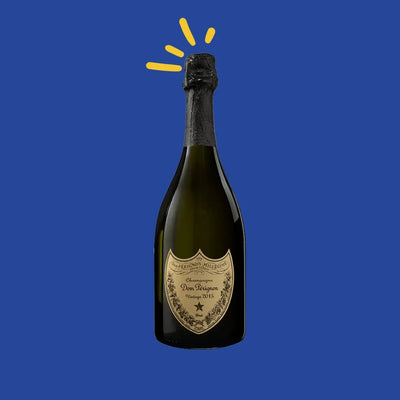
The vintage rule
The vast majority of champagnes are non-vintage bruts: they blend several harvests to achieve a consistent style from year to year. This is the economic foundation of the region.
Dom Pérignon does the exact opposite. Each bottle comes from a single harvest, and the cuvée is only produced when the year is judged worthy. In some years, it is not produced at all.
The consequences are significant. First, each vintage has its own personality, and two consecutive years can produce very different wines. Next, there is no safety net: it is impossible to correct a weak year with reserve wines. Finally, this creates a true collector's logic, with each vintage available in a finite quantity.
The blend
The cuvée combines Chardonnay and Pinot Noir in similar proportions, without Pinot Meunier. This is the balance that gives it its style: the tension and finesse of Chardonnay, the structure and fruit of Pinot Noir.
The Plénitudes, the house's most original idea
This is the concept that truly sets Dom Pérignon apart from other prestige cuvées, and it deserves to be understood.
The original idea: a champagne does not age linearly. It rather goes through distinct periods of expression, separated by more closed phases. The house chose to identify these windows and market the same vintage at several stages of its life.
- First Plénitude: the classic version, released after about eight years of aging on the lees. The wine is tense, precise, with still-vibrant fruit and pronounced minerality.
- Second Plénitude: the same vintage left on the lees for significantly longer, about fifteen years. The wine gains texture, intensity, and pastry notes, while retaining its tension.
- Third Plénitude: more than twenty years on the lees. A rare bottle, with deep tertiary notes.
An essential point to understand: these are not different wines, but the same wine at different ages, disgorged at different times. Aging on the lees before disgorgement is far more protective than aging after disgorgement.
The tasting profile
The Blanc Vintage
Pale gold color with green reflections. On the nose, citrus, white flowers, almond, a note of chalk, and, with age, brioche and dried fruit. On the palate, a tense attack, very fine bubbles, a creamy mid-palate, and a saline, long, slightly bitter finish, which is one of the cuvée's signatures.
See the Dom Pérignon Vintage 2015.
The Rosé
Produced in much smaller quantities, the rosé is a rarer cuvée and more complex to make. The profile changes: fresh red fruit, orange peel, a more winey structure, and very fine tannins perceptible on the finish.
It is a gastronomic champagne, not an aperitif. See our rosé champagnes.
How to serve it
- Temperature: 11 to 12 degrees. This is the most important advice in this article. Served at 7 degrees, a Dom Pérignon shows nothing.
- Glass: a wide white wine glass. Never a flute, never a coupe.
- Patience: leave it in the glass for ten minutes. The cuvée transforms significantly.
- At the table: it is a meal champagne. Fine fish, shellfish, Bresse poultry, sweetbreads. With an evolved vintage, an aged Comté or a truffle.
Frequently asked questions
How long does a Dom Pérignon last?
Vintages are marketed ready to drink after long aging, but they continue to evolve. Allow fifteen to twenty-five years after the vintage for a well-preserved wine, and even longer in a magnum.
Should you wait before opening it?
No, that is the whole principle: the house releases the bottles when it judges them ready. But a few extra years bring a creamier texture.
Why do some vintages not exist?
Because the year was not judged worthy. This is the direct consequence of the single-vintage rule, and it is what guarantees the quality.
How to store a bottle?
Lying down, in the dark, at a stable temperature between 11 and 14 degrees, away from vibrations. Keep the box if there is one: it protects from light.
Ordering a Dom Pérignon from Le Caveau des Pépites
For this type of bottle, traceability and storage conditions are crucial. We work directly to guarantee the origin of every bottle. Stored in our temperature-controlled, humidity-controlled warehouses in France, hand-packed and wrapped, shipped from mainland France via tracked and insured transport. Free delivery on orders over 300 euros. Customer service available 7 days a week, in French and English.
To learn more: limited artist editions, our buying guide, and our vintage champagnes.





