
Choose a non-vintage brut dosé between 8 and 10 g/l, with at least three years on the lees and a significant proportion of Pinot Noir. Served between 10 and 12°C in a tulip glass, it suits the aperitif, starter, and main course without tiring the palate.
What we ask of a champagne that must do it all
An aperitif champagne has only one mission: to whet the appetite over a few bites. As soon as it also has to accompany a scallop, roast capon, and sometimes a piece of Comté, the requirements change completely. It needs substance so as not to disappear behind a sauce, enough acidity to remain digestible over a three-hour meal, and a discreet dosage so as not to overwhelm the palate by the fourth glass.
Three families of champagnes almost systematically fail this test. Extra bruts, first: superb with an oyster, they become thin and almost metallic as soon as a dish brings richness. Then young blanc de blancs, perfect with a seafood platter but too short with stuffed poultry. Finally, generously dosed cuvées, pleasant at the first glass and tiring halfway through the meal, because the sugar adds up from one glass to the next.
The right candidate is in the middle: a full-bodied yet fresh champagne, built on a high proportion of reserve wines, capable of changing its register depending on what is on the plate.
Our pick for this article
The four deciding criteria
| Criterion | What to aim for | Why |
|---|---|---|
| Dosage | 8 to 10 g/l of sugar | Enough to round off the acidity, too little to overpower a savory dish |
| Blend | Minimum 40% Pinot Noir or Meunier | Black grapes provide the body that holds up against white meat |
| Cellar time | Minimum 3 years on the lees | Notes of brioche and hazelnut provide the link with cooked dishes |
| Reserve wines | High proportion in the blend | They bring the depth that avoids the sensation of a short wine |
The appellation requires a minimum of 15 months in the cellar for a non-vintage champagne, including 12 months on the lees, and 36 months for a vintage. These are regulatory minimums, not targets. Houses that far exceed these durations produce exactly the type of wine sought here: a champagne that has already begun its evolution in the bottle and no longer relies solely on liveliness.
Dosage, in figures
The terms on the label correspond to precise ranges of residual sugar per liter: brut nature or non-dosage from 0 to 3 g/l, extra brut from 0 to 6 g/l, brut up to 12 g/l, extra dry from 12 to 17 g/l, sec from 17 to 32 g/l, demi-sec from 32 to 50 g/l, sweet over 50 g/l. Most house bruts are now between 6 and 9 g/l, far from the 15 g/l commonly used in the 1980s. This is good news for a meal champagne: the sugar no longer masks the structure.
The grape varieties, concretely
Chardonnay brings tension, citrus, and length on the finish. Pinot Noir gives structure, red fruit, and roundness in the middle of the palate. Meunier ripens earlier, offers immediate fruit and generous volume, but ages less long. For a table champagne, a blend where black grapes slightly dominate, or balance with Chardonnay, is the safest choice.
Four bottles that hold up the entire meal
Gosset Grande Réserve Brut Gosset, from €48.50
Gosset does not use malolactic fermentation, which leaves a straight acidity and real tension on the palate even after several years in the cellar. The blend gives a large part to Chardonnay and Pinot Noir, complemented by Meunier. It is the choice of a table focused on fish, shellfish, and poultry, where it keeps its freshness from the first to the last glass. For those looking for a full-bodied champagne without any heaviness.
Billecart-Salmon Le Réserve Billecart-Salmon, from €49.99
The house in Mareuil-sur-Aÿ is known for its cold pressings and slow fermentations at low temperatures, two technical choices that give fine bubbles and a very clean palate. All three grape varieties are represented, with a Meunier that brings immediate fruit. Over a starter of scallops then a capon, the transition is seamless. A good first meal champagne if you fear wines that are too marked.
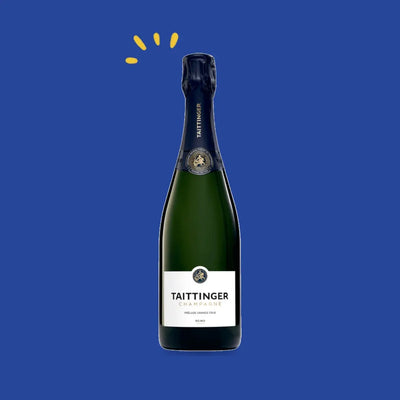
Taittinger Prélude Grands Crus Taittinger, from €62.90
Half Chardonnay, half Pinot Noir, only Grand Cru grapes, with about four years in the cellar before going on sale. The result is broader and riper than the house's entry-level brut, with white fruits and fresh almond. Bring out with the main course: lobster, stuffed poultry, festive risotto. For a table that wants a single wine from start to finish, without compromise.
Krug Grande Cuvée Krug, from €255
A blend of more than a hundred wines from at least ten different years, aged for at least six years in the cellar before commercialization. The palate is dense, buttery, with dried fruit and candied citrus, with a length that supports a creamy sauce or a truffle dish. It is a main course champagne, not an aperitif: open it when the plates arrive. For a table of four to six people who want a single striking bottle.
Service, where everything is won or lost
A meal champagne served at 6°C gives nothing: the cold numbs the aromas and hardens the acidity. The same bottle at 11°C changes dimension, the texture appears, the woodiness and pastry notes are finally readable.
| Type of champagne | Serving temperature | Moment of the meal |
|---|---|---|
| Young blanc de blancs | 8 to 10°C | Aperitif, shellfish |
| Non-vintage brut | 10 to 11°C | Aperitif and starter |
| Reserve brut or grands crus | 11 to 12°C | Main course |
| Vintage or prestige cuvée | 12 to 14°C | Main course, hard cheeses |
Cooling without brutalizing the bottle
Allow 3 to 4 hours in the refrigerator, or 20 to 30 minutes in a bucket half filled with water and half with ice: water conducts cold much faster than ice alone. The freezer remains an emergency solution not to exceed 15 minutes, and never for a prestige cuvée. Take the bottle out of the ice as soon as it is at temperature and leave it on the table: it will gain one or two degrees during service, which is desirable.
The glass and the gesture
Forget the narrow flute and the coupe. A tulip glass of 25 to 30 cl, filled to a third, allows the aroma to develop while preserving the effervescence. Pour in two steps: a little, while the foam subsides, then top up. Over an entire meal, one glass per guest is enough if you keep the same champagne from start to finish.
How many bottles to plan
A 75 cl bottle gives 6 glasses of 12.5 cl, or 5 well-served glasses of 15 cl. When champagne accompanies the entire meal and not just the aperitif, count half to two-thirds of a bottle per person.
| Guests | Aperitif champagne only | Champagne over the entire meal |
|---|---|---|
| 4 people | 1 bottle | 2 to 3 bottles |
| 6 people | 2 bottles | 3 to 4 bottles |
| 8 people | 2 to 3 bottles | 4 to 5 bottles |
| 12 people | 4 bottles | 6 to 8 bottles |
If you insist on a single cuvée for the whole evening, buy it in several copies of the same reference rather than mixing: the meal will keep its coherence and you will avoid involuntary comparisons between two styles. Our packages are carefully wrapped, with good protection to guarantee the condition of your bottles upon arrival.
The two cases where a single bottle is not enough
First case: a frankly sweet dessert. A brut over a chocolate log or a pastry cream becomes acidic and unpleasant, because the sugar of the dessert overpowers the little sugar of the wine. Plan a demi-sec for the end of the meal, or move on to something else.
Second case: a platter of washed-rind cheeses or a powerful blue. There, even a full-bodied brut is dominated. A more dosed champagne or a still wine will take over more elegantly. For the rest of the meal, from the aperitif to the main course, a single well-chosen cuvée does the job very well.
To go further
- What champagne for the December 24th aperitif
- The most frequent champagne mistakes at New Year's Eve
- Champagne and truffle: the most difficult pairing
Frequently asked questions
Blanc de blancs or blend for the entire meal?
A blend is safer. Blanc de blancs, 100% Chardonnay, shines on shellfish and seafood starters, but often lacks body on roasted poultry or a creamy sauce. A blend with 40% or more black grapes covers a larger part of the meal.
What quantity per person if champagne accompanies the entire meal?
Count half to two-thirds of a bottle per guest, i.e., 3 to 4 bottles for six people. A 75 cl bottle corresponds to 6 glasses of 12.5 cl, and a complete festive meal generally represents 3 to 4 glasses per person.
Should you decant a meal champagne?
It is not necessary and it is risky, because the decanter makes lose part of the effervescence. If a reserve champagne seems closed, prefer a wider glass and a service at 12°C rather than a decanter: the aeration will happen in the glass in a few minutes.
Is a vintage a better choice than a non-vintage brut?
Not necessarily for an entire meal. A vintage has at least 36 months in the cellar and more character, but it is also more typical of its year, so less flexible over a succession of dishes. A non-vintage brut rich in reserve wines is often more versatile.
One bottle, the entire meal
Selection of full-bodied and balanced champagnes, ready to go from the aperitif to the main course.
See all champagnesMore than 1,000 customers have already trusted us, with a rating of 4.9 out of 5. Shipping from France, payment in installments possible with Klarna.
The prices and availabilities mentioned are those observed at the date of publication and may change. The abuse of alcohol is dangerous for health, consume with moderation. Sale prohibited to minors.