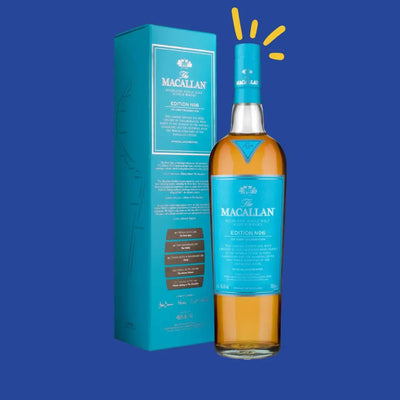
In the world of single malt, few names carry the weight of currency. The Macallan is one of them. Mention the distillery in any whisky bar in the world, and the conversation takes on a different tone.
This reputation is not the result of an advertising campaign. It rests on a series of precise technical choices, maintained for nearly two centuries, and on a bet made very early on: that of sherry oak. Here is how it works. You can also browse all available The Macallan bottles directly.
Easter Elchies, 1824
The Macallan is located on the Easter Elchies estate, near Craigellachie in Speyside, on a plateau overlooking the River Spey. The distillery obtained its official licence in 1824, making it one of Scotland's oldest legal distilleries, at a time when illicit production was the norm in the Highlands.
Speyside is now home to Scotland's highest density of distilleries. It generally produces fruitier, less peated whiskies than the west coast or Islay. The Macallan fits into this tradition, but with a density and richness of its own.
A new distillery since 2018
In 2018, the distillery opened a new production building, buried beneath a wavy roof covered in vegetation, designed to blend into the estate's landscape. The building has become an architectural destination in its own right, but its primary function remains industrial: to increase capacity without changing the shape of the stills.
Our pick for this article
The six pillars, and what they really mean
The distillery has long communicated about six pillars. Behind the marketing vocabulary are concrete production choices that explain the whisky's profile.
- The location: the Easter Elchies estate, and water drawn on site.
- Deliberately small stills: The Macallan's stills are among the smallest in Speyside. A small still offers greater contact between the distillate and the copper, resulting in a richer, denser new-make.
- A reduced heart cut: the distillery retains only a limited fraction of the distillate, cutting the heads and tails more broadly than average. We lose volume, we gain purity.
- The oak: the decisive pillar, detailed below.
- Natural colour: no caramel colouring added. The hue comes solely from the cask, which is far from being the general rule in Scotch whisky.
- The quality of the distillate: a consequence of the five above.
Sherry oak, a true signature
This is where The Macallan stands out most clearly. The distillery invested very early in a cask supply chain that it largely controls, and you can taste it.
The principle: European oak, notably from northern Spain, is air-dried for several years, worked in Spanish cooperages, and then used to hold sherry, most often oloroso, for an extended period. The cask is then emptied and filled with distillate.
What this brings to the whisky is highly recognisable: notes of dried fruit, Corinthian raisins, candied orange peel, sweet spices, cocoa, and precious woods, with a thicker mouthfeel and a deep, entirely natural amber colour.
Sherry Oak, Double Cask, Triple Cask
Three families structure the core range, and the difference between them is a matter of casks.
- Sherry Oak: exclusively European sherry oak. The darkest, spiciest, densest.
- Double Cask: European oak and American oak, both previously used for sherry. Softer, more vanilla, more accessible.
- Triple Cask Matured: American sherry oak, European sherry oak, and American bourbon oak. The clearest and most floral profile in the range.
The non-age statement series
For about fifteen years, The Macallan has largely developed ranges built not on age, but on the type of cask or on a tasting concept.
The 1824 Series classified whiskies by natural colour intensity, from lightest to darkest. The 1824 Series Sienna sits at the top of this scale: a deep copper colour, a nose of dried fruit and wood, and a spicy, warming palate.
The Edition series, numbered one to six, offered a different blend each year, often crafted around a theme. Edition No. 4 was built in echo of the new distillery's architecture, while Edition No. 6 concluded the series by drawing inspiration from the River Spey. These bottles are no longer produced, which explains their current status on the secondary market.
Thematic collections
The distillery also releases collections built around a pairing or a theme. Fine Cacao is a good example: a blend designed to dialogue with high-quality chocolate, where the cocoa notes naturally brought by sherry oak are highlighted.
The Folio Series, meanwhile, draws from the distillery's advertising archives. Each volume is presented in a box imitating a book and reproduces historical visuals. See Folio 8.
How to enjoy a Macallan
A whisky of this density deserves a few basic precautions.
- The glass: a tulip glass, such as a copita or Glencairn, never a wide tumbler. The narrowing of the neck concentrates the aromas. The Macallan has also developed dedicated glasses, such as the TIME: SPACE glass.
- The temperature: room temperature. Cold completely closes the dried fruit and spice notes.
- The water: just a few drops, and only at a high proof. On a 40 or 43 proof, refrain.
- The ice: to be avoided on limited editions. If you insist on cold, use a large stone or a single large ice cube.
- The time: let the glass rest for ten minutes. A Macallan changes significantly between the first and third approach.
Frequently asked questions
Why is The Macallan more expensive than most single malts?
Three factors combine: the very high cost of European oak sherry casks, a reduced heart cut that decreases usable volumes, and sustained global demand, notably in Asia, on a stock that is by definition limited.
Are non-age statement editions less good than the 12 or 18 year old?
No, they are different. A non-age statement series allows for the blending of casks chosen for a precise profile, without the constraint of a minimum vintage. Some Editions are unanimously considered superior to classic age statement bottlings.
Should you open a collector's bottle?
It is a personal decision. A whisky no longer ages in the bottle, unlike wine: there is therefore no gustatory gain in waiting. However, discontinued series will not return.
How to store a bottle of whisky?
Upright, never lying down, away from direct light and at a stable temperature. Lying down, the whisky attacks the cork, which eventually alters the contents and compromises the seal.
Ordering a The Macallan from Le Caveau des Pépites
We work directly to guarantee the origin and traceability of each bottle, an essential point for such a counterfeited name. The bottles are kept in our climate-controlled, humidity-controlled warehouses in France, hand-stacked and packed, then shipped from mainland France via tracked and insured transport. Free delivery from 300 euros. Customer service available 7 days a week, in French and English.
To learn more: our The Macallan buying guide, our whiskies and our spirits.