




Short answer: champagne for the aperitif and seafood, champagne or Sauternes with foie gras, a fine white or elegant red with capon, a structured red with game, and a demi-sec or nothing with the Yule log. Allow one bottle per person for the entire meal.
To see our selection, browse our gift ideas and our champagnes.
The aperitif
A brut or extra-brut champagne. It is the absolute safe bet: it pleases everyone and whets the appetite rather than overwhelming it.
- A blanc de blancs if you are serving seafood next.
- A Pinot Noir-dominant blanc de pays if you are serving charcuterie or hearty toasts.
- A rosé for a splash of colour on the table and to accompany smoked salmon.
See the Perrier-Jouët Blanc de Blancs and the Veuve Clicquot Rosé.
The mistake to avoid
Serving champagne ice-cold at 5 degrees. At this temperature, all that remains is the effervescence and the acidity. Aim for 10 to 12 degrees.
Our pick for this article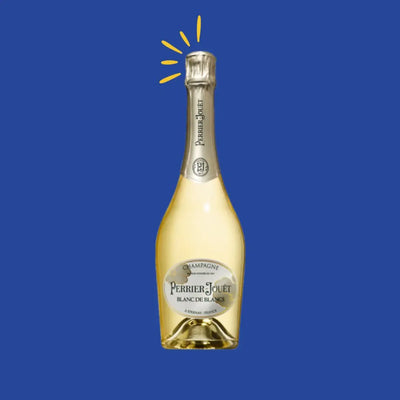
Seafood
A young Chablis, Muscadet sur lie, Picpoul, or blanc de blancs champagne.
See the Chablis 2023 Grand Regnard and our detailed guide to seafood pairings.
Foie gras
Three schools of thought, all defensible.
- Sauternes or sweet wine: the classic pairing, sweetness against fat.
- Extra-brut champagne: the contrasting pairing, lighter for the start of a meal.
- A fine dry white: Meursault, Alsatian Riesling, Châteauneuf-du-Pape blanc.
See our complete guide to foie gras.
Capon, turkey or guinea fowl
This is the most common dish, and most often poorly paired.
The meat is delicate and lean. A powerful red would completely overpower it.
With a white
- A fine Chardonnay from the Côte de Beaune: Meursault, Chassagne. The richness of the wine complements the sauce.
- A Châteauneuf-du-Pape blanc: full-bodied, original, perfect with creamed poultry. See the Clos La Roquète blanc 2023.
With a red
- A Burgundy Pinot Noir: it is the benchmark pairing for poultry. See the Chorey-lès-Beaune 2023.
- A mature Saint-Julien or Pomerol: if the poultry is stuffed and rich. See the Château de Sales.
With chestnut stuffing
The stuffing changes everything: it adds sweetness and body. A more structured Pinot Noir or a red from the southern Rhône becomes possible.
Game
Roe deer, wild boar, hare, woodcock. Here, you need power.
- A mature Châteauneuf-du-Pape: see the Clos des Papes 2021.
- An Hermitage or Côte-Rôtie: see the Ermitage Le Pavillon 2014.
- A mature fine Bordeaux: see the Lafite Rothschild 2011.
- A mature Languedoc: see La Grange des Pères 2022.
The cheese board
Contrary to French custom, white often works better than red.
- Pressed cheeses: Comté, Beaufort. A Jura white or an oaked Chardonnay.
- Goats' cheese: Sancerre, Menetou-Salon, Chablis.
- Blue cheeses: Sauternes or Port. The sweet and salty pairing is unbeatable.
- Soft cheeses: champagne, or a light red.
If you only want one wine: keep a little of the white from the main course.
The Yule log and dessert
This is the most difficult moment.
The rule
The wine must always be sweeter than the dessert. Otherwise it will seem acidic and thin.
- Chocolate Yule log: a Banyuls, a Maury, or a Port. A brut champagne would be completely wrong.
- Fruit Yule log: a demi-sec champagne or a late harvest wine.
- Praline Yule log: a sweet natural wine or an aged rum.
- If you are unsure: serve nothing, or a tea. It is more elegant than a bad pairing.
See our guide to champagne dosage.
How many bottles to allow
Simple rule of thumb: one bottle per adult for a full meal lasting several hours.
For ten adults
- 3 bottles of champagne for the aperitif and starter.
- 2 bottles of white.
- 4 bottles of red.
- 1 bottle of sweet wine for the foie gras and dessert.
Always allow one more bottle than your calculation. An unopened bottle can be kept; the reverse is not true.
The order of service
- From lightest to most powerful.
- From driest to sweetest.
- From youngest to oldest, of comparable quality.
- White before red, unless the white is very rich.
Frequently asked questions
Can you serve champagne throughout the meal?
Yes, and it is an excellent idea if you vary the styles: blanc de blancs for the aperitif, blanc de pays for the main course, rosé or demi-sec for dessert.
Should bottles be opened in advance?
Decant young reds two hours beforehand. Champagnes and whites are opened at the time of serving.
How to manage temperatures?
Take the reds out of the cellar the day before, chill the whites three hours beforehand, and use a bucket of water and ice for the champagnes.
What budget for a good result?
Three good bottles are better than six mediocre ones. See our finds for under 100 euros.
Order your festive wines from Le Caveau des Pépites
We work directly with producers to guarantee the origin and traceability of every bottle. Stored in our climate-controlled, humidity-regulated warehouses in France, hand-packed and wrapped, shipped from mainland France via tracked and insured transport. Free delivery on orders over 300 euros. Customer service available 7 days a week, in French and English.
To go further: our magnums and our favourites.





