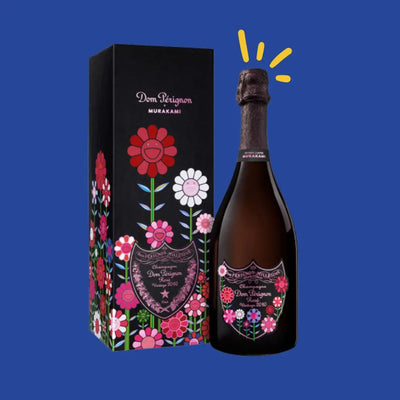
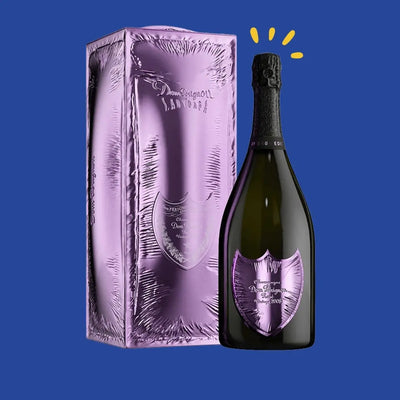
For several decades, Dom Pérignon has regularly entrusted contemporary artists with the design of its bottles. Andy Warhol, Jeff Koons, David Lynch, and many others have lent their creative worlds to these series.
These editions have become a collector's market in their own right. Here is how to understand them and what to check before buying one. To see what is available, visit the Dom Pérignon collection.
The concept: the same wine, a different design
One essential point to establish from the outset: in the vast majority of cases, the wine contained in an artist edition is identical to that of the corresponding standard vintage. What changes is the label, the box, and sometimes the bottle itself.
This does not detract from their appeal, but it clarifies what you are buying: an object, not a different wine. A connoisseur who simply wants to drink should buy the standard vintage. A collector, or someone buying a gift, will find in the limited edition a value that the classic bottle does not have.
Our pick for this article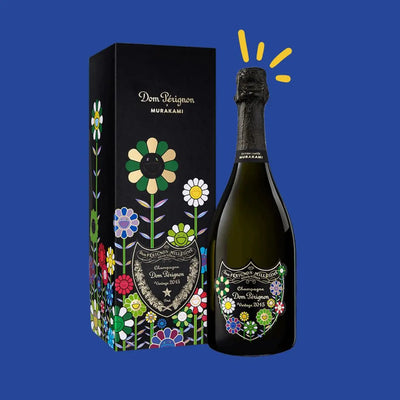
Available editions
Takashi Murakami
The Japanese artist, known for his smiling flowers and an aesthetic that blends pop art with Japanese tradition, created a particularly distinctive series.
Two pieces are available: the Dom Pérignon Murakami Vintage 2015 and the Dom Pérignon Murakami Rosé 2010. The rosé is the rarer of the two, as the rosé cuvée itself is produced in much smaller quantities.
Lady Gaga
A collaboration that stood out for its scale, featuring highly recognizable sculptural design.
Two bottles are available, both rosé: the Rosé 2008 Lady Gaga and the Rosé 2006 Lady Gaga Luminous.
The Luminous version deserves a clarification: it is a bottle with built-in lighting, designed for evening service. It is a specific format, and the 2006 rosé vintage is already old, which adds to its rarity.
Damien Hirst
The British artist, a major figure in contemporary art, created a series with a highly refined aesthetic.
Two pieces are available: the Vintage 2018 Damien Hirst and the Rosé 2010 Damien Hirst.
What creates rarity
- Limited edition: these series are produced in defined quantities and are never reissued.
- Vintage: an artist edition of an older vintage combines two forms of rarity.
- Rosé: the rosé cuvée is produced in much smaller volumes than the white. An artist edition in rosé is therefore doubly rare.
- The box: in this market, a bottle without its original box loses a significant portion of its value.
What to check before buying
Dom Pérignon is one of the most counterfeited brands in the world, and limited editions are particularly exposed. Here are a few basic points to check.
- Provenance: the seller must be able to explain where the bottle came from. An opaque chain of custody is a red flag.
- The fill level and condition of the capsule: any sign of tampering should raise questions.
- The box and documents: check their presence and condition.
- Storage conditions: a poorly stored champagne is beyond repair, regardless of how beautiful its label is.
- Price consistency: a bottle priced significantly below market value is not a good deal.
Open or keep?
This question is more relevant here than with a standard vintage, and it deserves an honest answer.
First point: unlike a spirit, champagne evolves in the bottle. A properly stored Dom Pérignon gains complexity for years, then eventually declines. Therefore, keeping a bottle indefinitely is not neutral for the wine.
Second point: discontinued editions will not be reissued. If you are interested in the bottle as an object, keeping it sealed makes sense.
We do not offer any investment advice. The limited edition market is volatile, and past performance guarantees nothing. Buy it first because you like the bottle.
Storing a limited edition
- Horizontally, to keep the cork moist, unlike spirits.
- In complete darkness: light degrades champagne very quickly.
- Stable temperature between 11 and 14 degrees, without sudden fluctuations.
- Away from vibrations, far from household appliances.
- Keep the box: it protects against light and contributes to the value.
Frequently asked questions
Is the wine different in an artist edition?
Generally, no. It is the same vintage, in a different design. The added value is aesthetic and related to rarity.
What is a Luminous bottle?
A bottle equipped with a built-in lighting device, designed for evening service. It is a specific format that adds to the rarity of the edition.
Is an artist rosé rarer than a white?
Yes, significantly. The rosé cuvée is produced in much smaller volumes, and a limited edition rosé therefore combines two forms of rarity.
Should you buy an artist's complete series?
This is the instinct of collectors, and the most expensive one. If you are starting out, prioritize the pieces that are hardest to find, generally the rosés and older vintages.
Ordering a limited edition from Le Caveau des Pépites
For this type of bottle, traceability is essential. We work directly to guarantee the origin of every bottle. Stored in our climate-controlled, humidity-controlled warehouses in France, hand-packed and wrapped in reinforced packaging, shipped from mainland France via tracked and insured transport. Free delivery on orders over 300 euros. Customer service available 7 days a week, in French and English.
To learn more: the history of Dom Pérignon and the Plénitudes and our limited editions.